

HR service providers, be it payroll, employee insurance or leasing companies, often see their digital transformation as: offering integration of their mainframe applications with the accounting package of employers. If they happen to offer an app for employees, they often see it as a ‘digital window’ onto pdf documents generated for legal or tax purposes.
Yet, their business models are seriously under threat: they feel the heat from apps for time registration, mobility-as-a-service and banking. And they also feel the heat from ERP packages and accounting software that offer a user interface to employees.
The HR services industry is focused on managing HR processes that are driven by HR managers. The employee is kind of an afterthought and is often confronted with all kinds of administration issues that they may understand or not, but that they typically hate. They hate the administration because they do not see value for them. And the HR manager tells them they need the processes for legal reasons, for reasons of control and audit, for tax purposes, and so on. But is this focus on ‘processes’ going to work in the future? Will employees also want to receive value from HR processes?
This post describes how an HR Services Provider can transform itself to evolve from an employer-centric B2B focus to a more employee-centric B2B2C focus and generate network effects.
How would employee-centricity look like?
We’ll illustrate employee-centricity as a key differentiator using a story about BestTeams, a (fictitious) employer and their (fictitious) HR Services Provider HR2me. Let’s imagine I’m Peter, looking for a new job. The story goes as follows…
“While searching for a new employer, one of my criteria was the attention the company was giving to its employees. Would they really care about my well-being, my career and my skills development, or would I just be an additional headcount?
So I found BestTeams who were ranked very high by their employees at Glassdoor. They even won one of the best-employer awards last year.
When I applied, the HR director suggested I’d install the app of their HR services provider, called HR2me. Why would I download an app to apply for a job? HR2me promised that by using the app, I could start managing my own career independent of my employers and I could compare my salary package with peers. Well, that sounded intriguing.
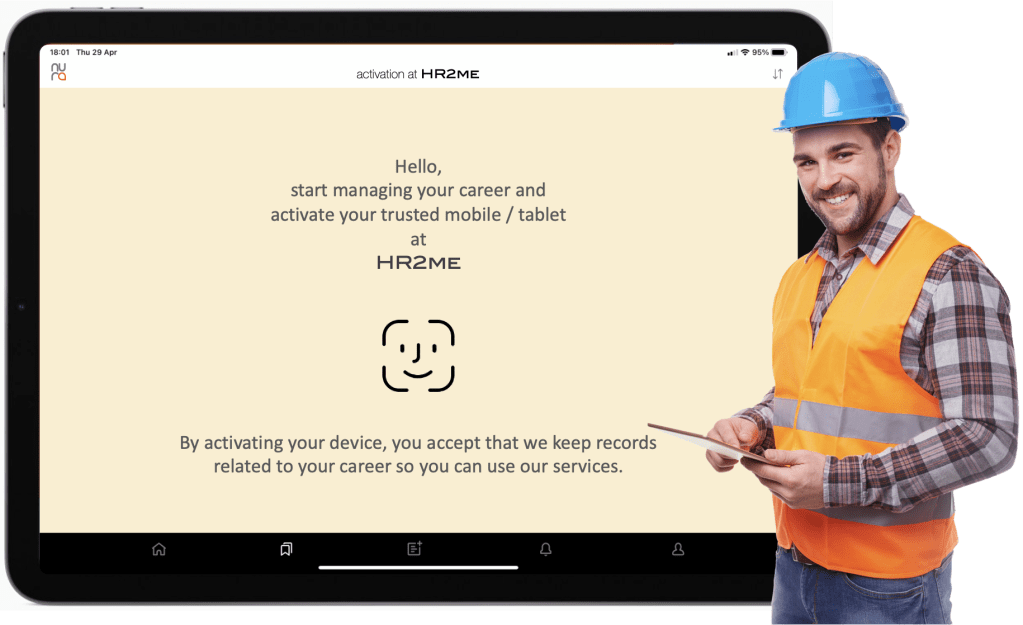
So I installed their app and set up an account using my LinkedIn profile and giving my consent to share my public profile with them. The app asked me to confirm that I owned my tablet using face-id. It turned out that by doing so, all my career and payroll related information would only be accessible by me. All I had to do for any future access, was to confirm my face-id on my tablet. Without it, my records could not be accessed. This even protected me against phishing. And this without using any password. HR2me really cared about me. Cool!
Applying was simple: I scanned the QR code of the vacancy, uploaded my CV and added my enthusiastic cover note. A few hours later, BestTeams’ HR director An had read my CV and notified me through the app that they were interested to meet me. When I saw the alert, I really jumped for joy and booked an appointment, again through the app and after I gave my consent that HR2me could share some of my information with BestTeams.
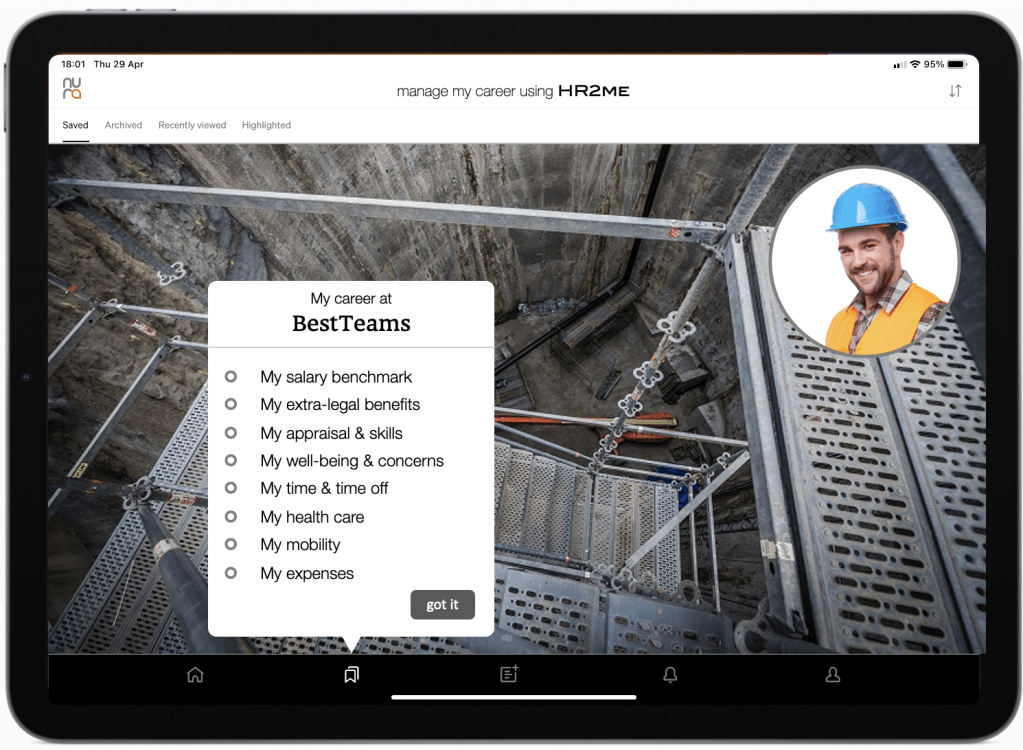
The interviews went well and I really appreciated the way BestTeams was treating their candidates and employees. So they proposed me a contract through the app. Using the app I could compare the proposed salary package with peers with a similar profile in my vicinity. It was not the highest salary, but the total package of training, coaching, appraising and remote working was more than enough to convince me. So I signed the contract… digitally through the app after I confirmed my identity with my national-ID card. When I started at BestTeams, I was invited to link my company email address with my account at HR2me to ease further HR-related communication.
I’m now working more than two years at BestTeams, and they are really great. Not the least thanks to their choice of HR2me for handling all HR matters. For example, when I want to take vacation, I use the app and book it. My team leader Francis reviews my request and if the team can handle my absence, he approves it promptly.
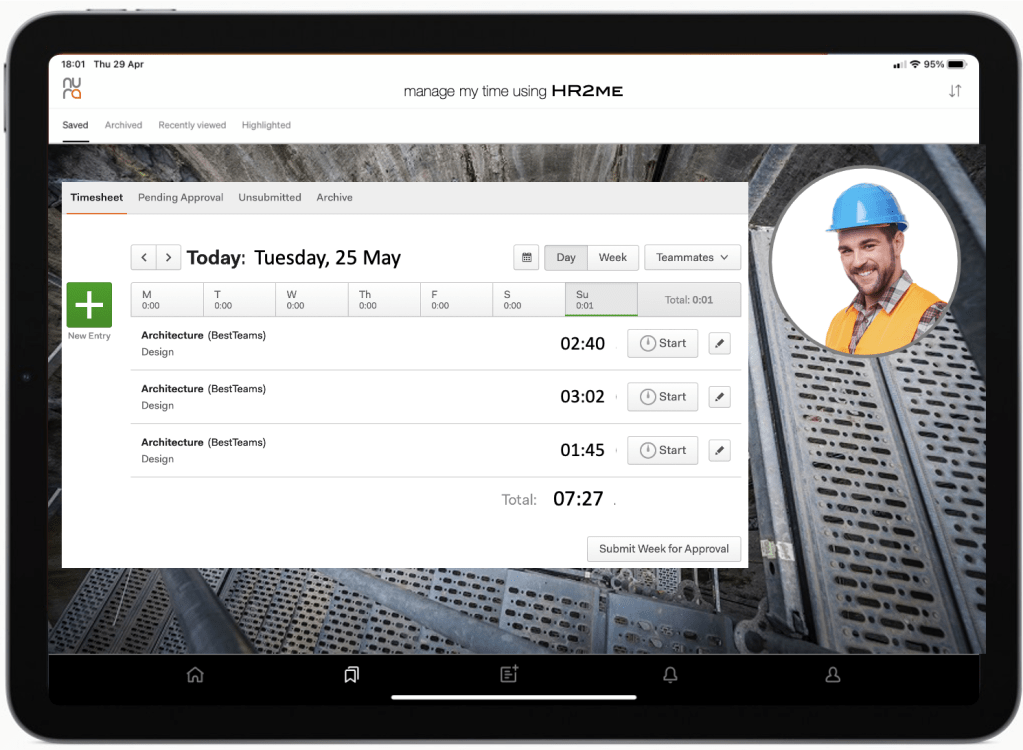
I also use the app for registering my hours. I found this pretty boring initially, but later I found out that I could announce sickness the same way. BestTeams also told me that registering the hours allowed me to work from home at any time, as long that it was OK for the team. Because it helped me manage my time better and more flexibly, I made sure I registered the hours meticulously and timely. Everybody a winner!
My wife Hanna needed to undergo surgery that was fortunately insured thanks to the health insurance a got from BestTeams. She asked me whether she could issue the insurance claim herself. All I needed to do was invite her through the app.
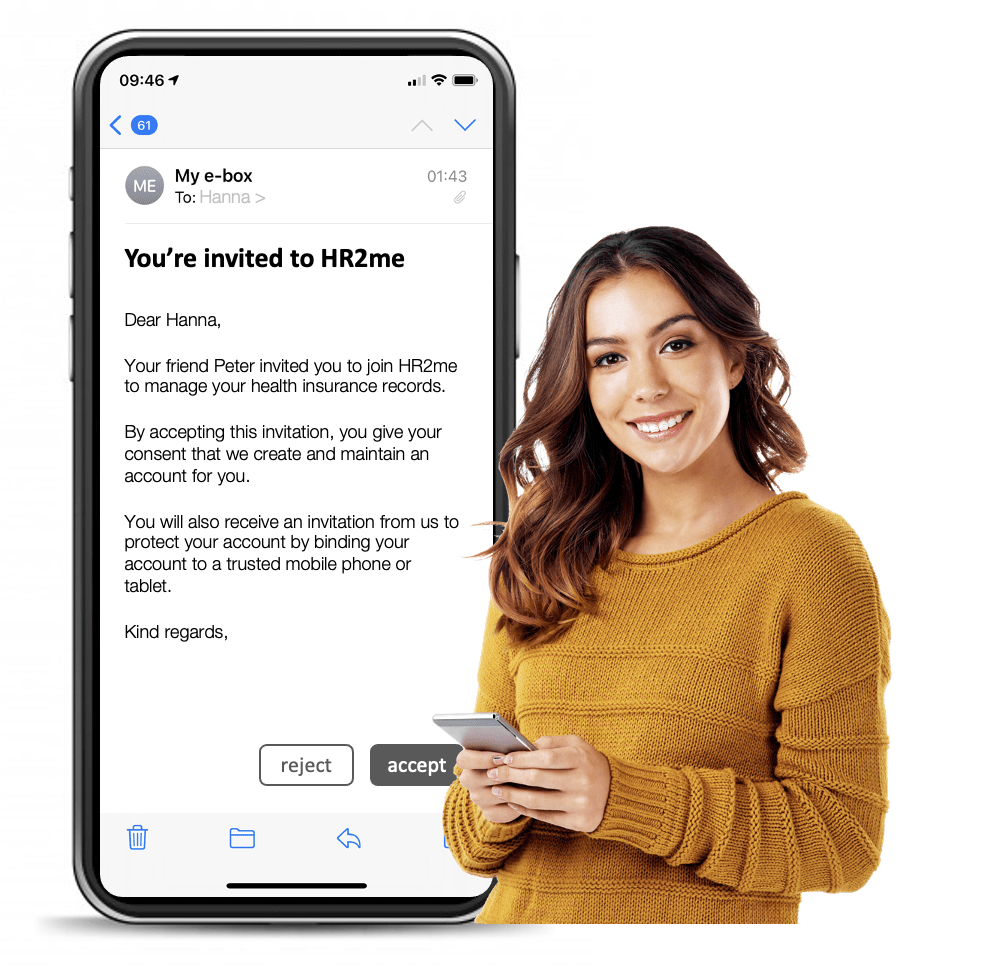
Through the invitation, she also got an account at HR2me with which she follows up her claim. It turned out that, thanks to her HR2me account, she can also enter expense notes and have them issued to her own employer. Knowing that her employer is not (yet) an HR2me customer, we assume HR2me made a connection with their accounting package or so. Cool.
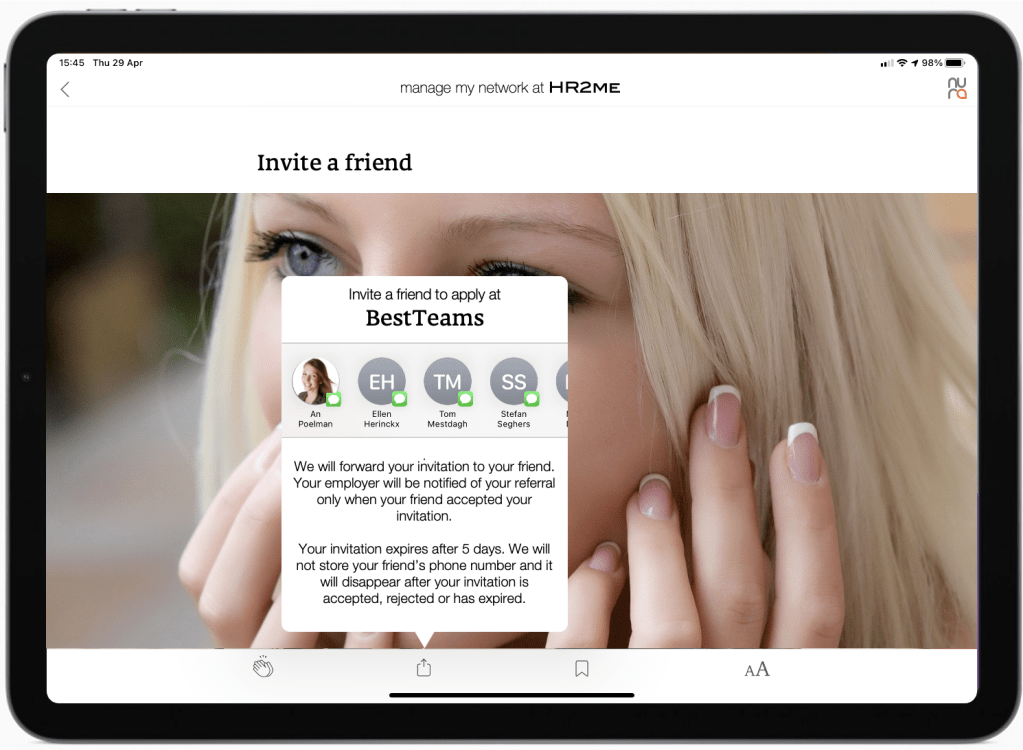
I really felt that both BestTeams and HR2me were taking care of me. When I told my friend Joëlle about this culture, she asked me how to install the HR2me app. So, I invited her to HR2me, again simply through the app. She got a message on her phone to install the app and create an account.
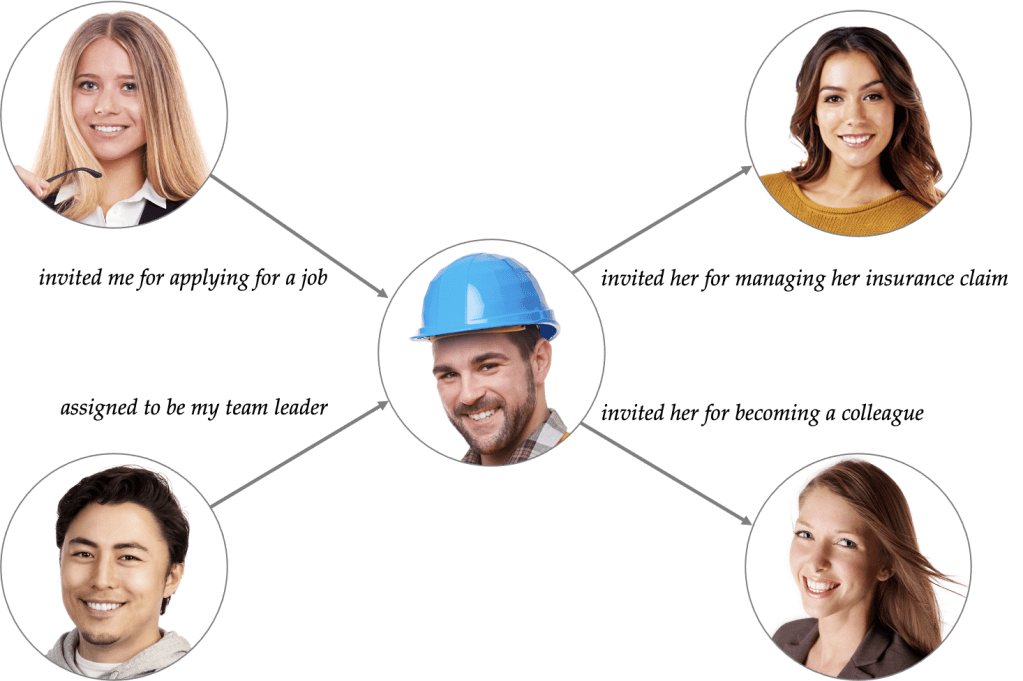
And naturally, she also applied for a job at BestTeams. Immediately after she signed her contract, I got a notification in the app that I gained a 500€ referral bonus. Wow. Now both of us are happy employees at BestTeams, taking our professional destiny in our own hands thanks to HR2me.“
So What?
Remember that the story is not about a (fictitious) app. It is about redirecting the focus of the HR services: from being HR manager centric, they are transformed to employee-centric. While employers remain the customer, it is the employee who is taken care of.
Employees may become influencers and drivers behind the choice of HR service provider. Employees may start generating network effects. For employee-generated network effects to happen you first need to make sure employees receive value on their own. The example taken here is salary benchmarking, which is something an HR service provider is uniquely positioned for.
The employee-generated network effects start when they influence their friends. By creating a “I want this, too” effect, people become ambassadors of services that appeal to them as employees (rather than just appealing to HR managers). The service delivery transformed from B2B to B2B2C.
What is needed?
Since we are dealing with sensitive information that should not be leaked or manipulated, access to the Peter’s data must be controlled very strictly with a bit of nuance:
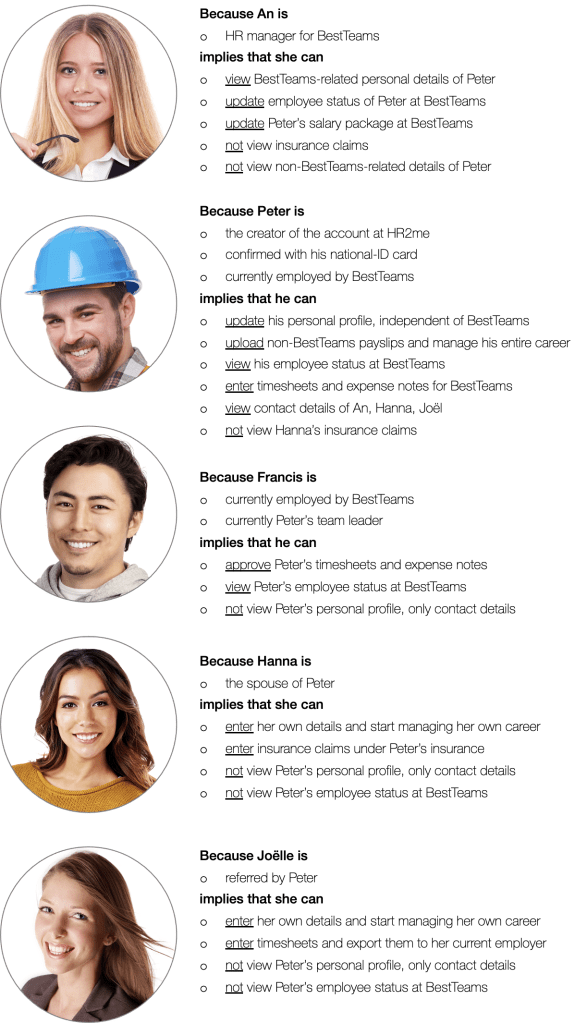
From a security and privacy point of view, what you need in order to transform HR services to become employee-centric is:
- Frictionless registration that is not linked to the employer, yet it must be very secure. If it causes too much hassle before you can start, the “I want this, too” effect will disappear. But since we are talking about sensitive information and about legally binding information, the registration must be protected with state of the art authentication.
- Consent management that is specific and to the point. Ensure that consents are not implied by cookies and that consents can be managed by the employee, so that they can for example revoke their consent for a certain application.
- Policy-based authorisation that scales to a consumer environment but that acknowledges the different roles and mandates people may have. An HR manager has a different role than the team leader approving time registration. When applying for a new job, a person may have a role of job seeker, which is different from their role as employee. The policy server will also need to manage workflows to enable approvals and invitations. It will also need to take consents into account.
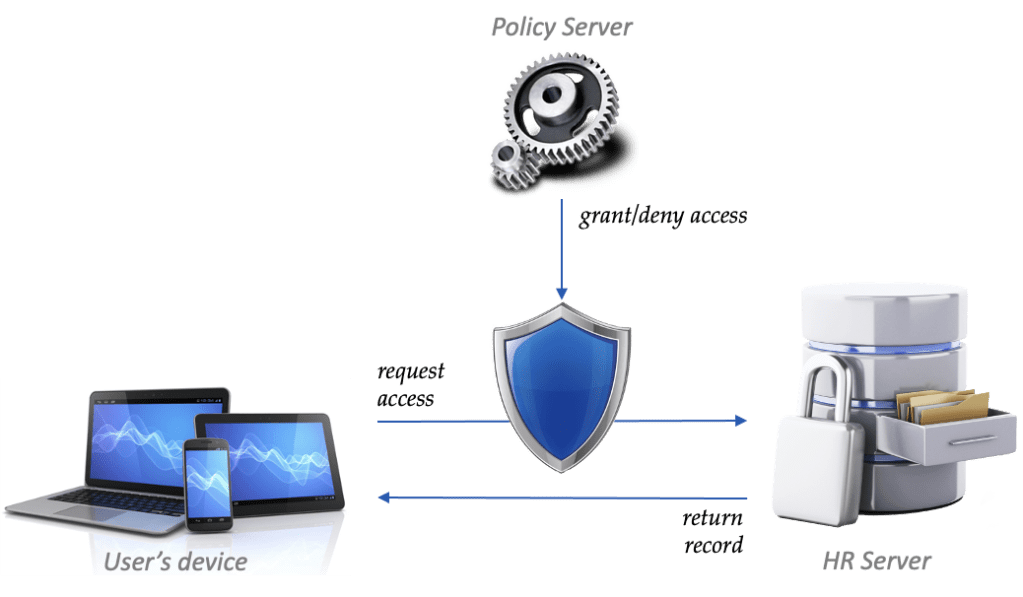
Following components will be critical:
- You need secure activation system using social accounts, e.g. LinkedIn. Onboarding employees using social accounts reduces friction: no password and no forms. Moreover, using the principles of anonymous login (see How to implement anonymous login?) an employee account is protected by binding it to a trusted device rather than to a user-id/password.
- Do you need a CIAM? The aforementioned procedure does not require a user-id/password and does not assume a CIAM solution in place. It can work alongside a CIAM, though.
- You need a Policy Server to uniformly apply business rules for all access by employees, both people under contract with one of the customers and people looking for a job. See our post on How to implement policy enforcement? on how this can work using standardised protocols. And please, do not use method-1 as this can easily be bypassed by consumers.
- You need a link between the Policy Server and your HR database that manages records for employees. This way the Policy Server can grant access to sensitive information using roles and contractual details of the person.
- You need a link between the Policy Server and authoritative sources for identity proofing, such as national registries offering people’s public identity.
Notes
Please read our posts on other consumer-centric digital transformations:
 Controlled AI services