
Governed Ecosystem Sharing for the Agentic AI era
From fragmented evidence to shared intelligence and coordinated action across organisations and AI agents.
Organisations increasingly use AI agents to retrieve information, interpret documents, evaluate situations and initiate actions. But these agents typically operate within the information systems, responsibilities and boundaries of the organisations deploying them.
That becomes a problem when several independent organisations are involved with the same asset.
Each may hold different information, describe the same entities differently, reach different conclusions and operate under different access rights.
Connecting their applications—or their AI agents—does not necessarily establish a consistent understanding of the underlying asset.
Sharing information is not the same as sharing knowledge. And sharing knowledge is not the same as coordinating action.
FlowPilot Governed Ecosystem Sharing provides reusable machinery to connect all three.
One dog. Many independent actors.
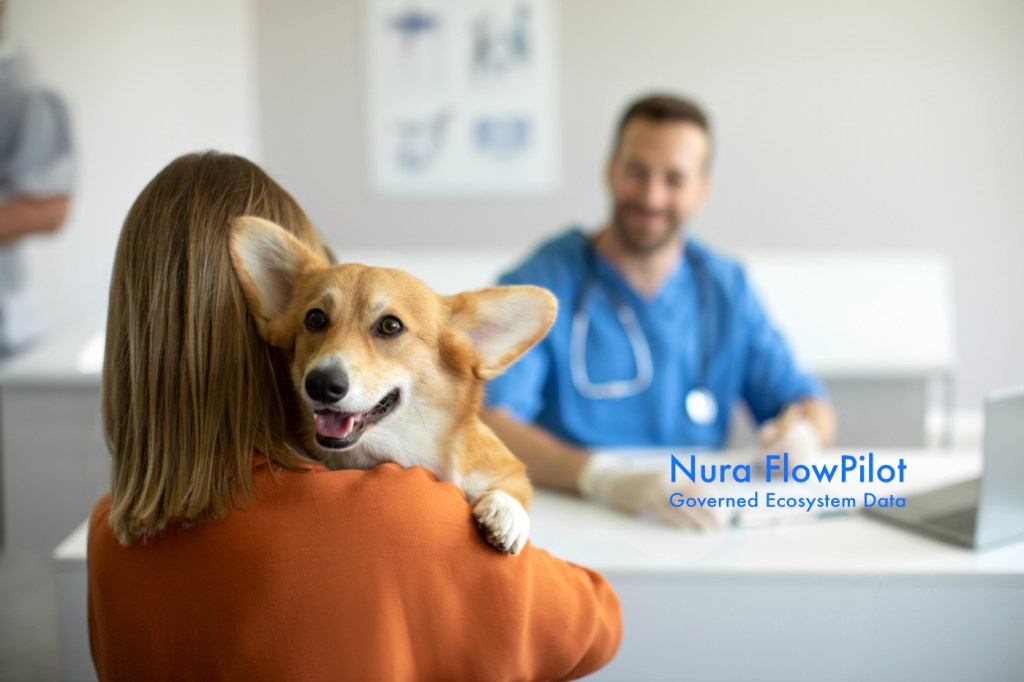
Consider a dog.
A breeder records its identity, pedigree, breed and characteristics. A veterinarian examines the puppy, administers vaccinations and maintains its medical history.
A prospective buyer may receive information about its pedigree and health, but should not necessarily have access to everything the breeder or veterinarian knows.
Eventually, someone buys the dog. Ownership changes, along with the relationships, responsibilities and access rights surrounding the animal.
The new owner may choose another veterinarian. Over time, trainers, boarding facilities, insurers and perhaps subsequent owners become involved.
The dog remains the same. The actors, their relationships and their responsibilities change.
Meanwhile, the dog accumulates a growing body of evidence: registrations, pedigree certificates, vaccination records, laboratory results, medical observations, treatments and insurance documentation.
Yet this information is distributed across independent systems, maintained by organisations with different interests and responsibilities.
The dog does not belong to any one information system. Its identity, characteristics and history transcend organisational boundaries.
This reveals a fundamental mismatch:
Enterprise software is predominantly organised around actors, while many real-world activities are organised around shared assets.
From fragmented information to governed intelligence
FlowPilot addresses this problem through three complementary capabilities.
1. Canonicalise evidence into shared knowledge
Imagine the same dog appearing in several systems under different names, identifiers or descriptions.
A veterinarian records an allergy. A laboratory provides test results. An insurer holds an earlier medical declaration. A boarding facility maintains its own care instructions.
Simply connecting these systems does not establish whether their records refer to the same animal, whether observations contradict each other or which conclusions are supported.
FlowPilot processes heterogeneous evidence, extracts facts, resolves entities and relationships, and maintains a traceable knowledge representation of the dog.
Domain-specific quality-control rules can evaluate whether expected evidence is present, current and consistent.
Contradictory observations remain visible as distinct, source-attributed claims until they can be reconciled.
The result is not another repository of documents, but an evolving, evidence-grounded understanding of the animal.
2. Share insights under governed authority
Not everyone involved with the dog needs access to the same information.
The owner may need the complete medical history. A boarding facility may need to know about allergies and medication. An insurer may be entitled to specific declarations. A prospective buyer may receive only selected information.
FlowPilot determines what each participant may know and do according to their relationship with the animal, their capacity and the applicable policies.
These principles apply to AI agents as well as people.
An agent acting for a boarding facility should receive the information necessary to provide appropriate care, not unrestricted access to the dog’s entire history.
The objective is not universal visibility. It is appropriate visibility across independent actors.
3. Propagate findings and coordinate remediation
Suppose a veterinarian identifies an allergy that conflicts with existing care instructions.
Recording the allergy is only the beginning.
The owner may need to be informed. The boarding facility may need updated instructions. Another veterinarian may need to review a previous treatment.
FlowPilot connects the new evidence and resulting findings to the appropriate participants and actions.
Requests and remediation activities can be directed to those responsible, under the appropriate authority and visibility constraints.
When new evidence or corrected instructions become available, the affected knowledge and assertions can be re-evaluated.
Completing a task does not necessarily mean resolving the underlying issue. Resolution must be established against the evidence.
Why this matters in the agentic AI era
Imagine that each participant now deploys its own AI agents.
The breeder has an agent managing registrations and pedigree information. The veterinarian has an agent assisting with medical records. The insurer uses agents to evaluate claims. The boarding facility uses an agent to prepare care instructions.
These agents may be highly capable within their respective systems. But who ensures that they refer to the same dog, interpret shared evidence consistently, respect each other’s information boundaries and act upon relevant changes?
Without a common foundation, each agent may maintain a different understanding of the animal.
FlowPilot provides a shared-asset perspective connecting canonicalised evidence, governed authority and coordinated action.
Agents can participate in this ecosystem without each having to independently implement the complete machinery for identity reconciliation, evidence evaluation, controlled information sharing and remediation.
Controlled propagation: from evidence to action and back
Consider the newly discovered allergy: New medical evidence → Canonicalised knowledge → Evaluated finding → Governed sharing → Updated care instructions → New evidence.
FlowPilot establishes what has changed and which conclusions are affected. It determines which participants are entitled to know and what actions they may undertake.
Relevant findings and remediation requests can then be propagated to the appropriate people, agents and systems. Their responses may introduce new evidence, triggering further evaluation.
This creates a continuous relationship between knowledge, authority and action, without requiring every organisation to surrender control of its own systems.
Two lifecycles. One shared asset.
Two independent lifecycles are fundamental to FlowPilot.
The asset’s knowledge lifecycle: As the dog grows, its identity remains stable while its characteristics, health, evidence and associated conclusions evolve.
The participants’ relationship lifecycle: Breeders, owners, veterinarians and other participants establish, change and terminate their relationships with the dog. Their authority and information visibility change accordingly.
A change in ownership should not erase the dog’s medical history. Nor should a former owner’s access rights necessarily persist after the relationship ends. FlowPilot connects these lifecycles while preserving their independence.
This is particularly important for agentic AI, where agents may participate temporarily, under delegated authority, and operate at machine speed.
Built for ecosystems, not just individual applications
FlowPilot Governed Ecosystem Sharing is part of FlowPilot Studio, a horizontal platform for intelligence about shared assets. It provides reusable machinery for evidence canonicalisation, entity resolution, knowledge representation, quality-control evaluation, governed sharing and remediation coordination.
Domain specialists contribute the relevant evidence profiles, vocabularies, assertions and evaluation criteria.
Software vendors and OEM partners integrate these capabilities into their applications, repositories and workflows.
FlowPilot Governed Conversational Intelligence builds on this foundation, enabling AI to investigate unexpected relationships and propose new assertions for expert validation.
Governed Ecosystem Sharing establishes, evaluates and propagates what is known. Governed Conversational Intelligence investigates what else we should know.
Different assets. Different organisations. Different agents.
One governed foundation for shared intelligence and coordinated action.
Find out more products of FlowPilot Studio
FlowPilot | Governed Authority & Access
Manages the question: Who may know and do what? It provides contextual authorization through personas, delegation and policies.
[Explore FlowPilot Authority →]
FlowPilot | Governed Conversational Intelligence
Manages the question: What does that knowledge mean? It provides conversational investigation combining flexible LLM reasoning with evidence-grounded, deterministic evaluation.

